
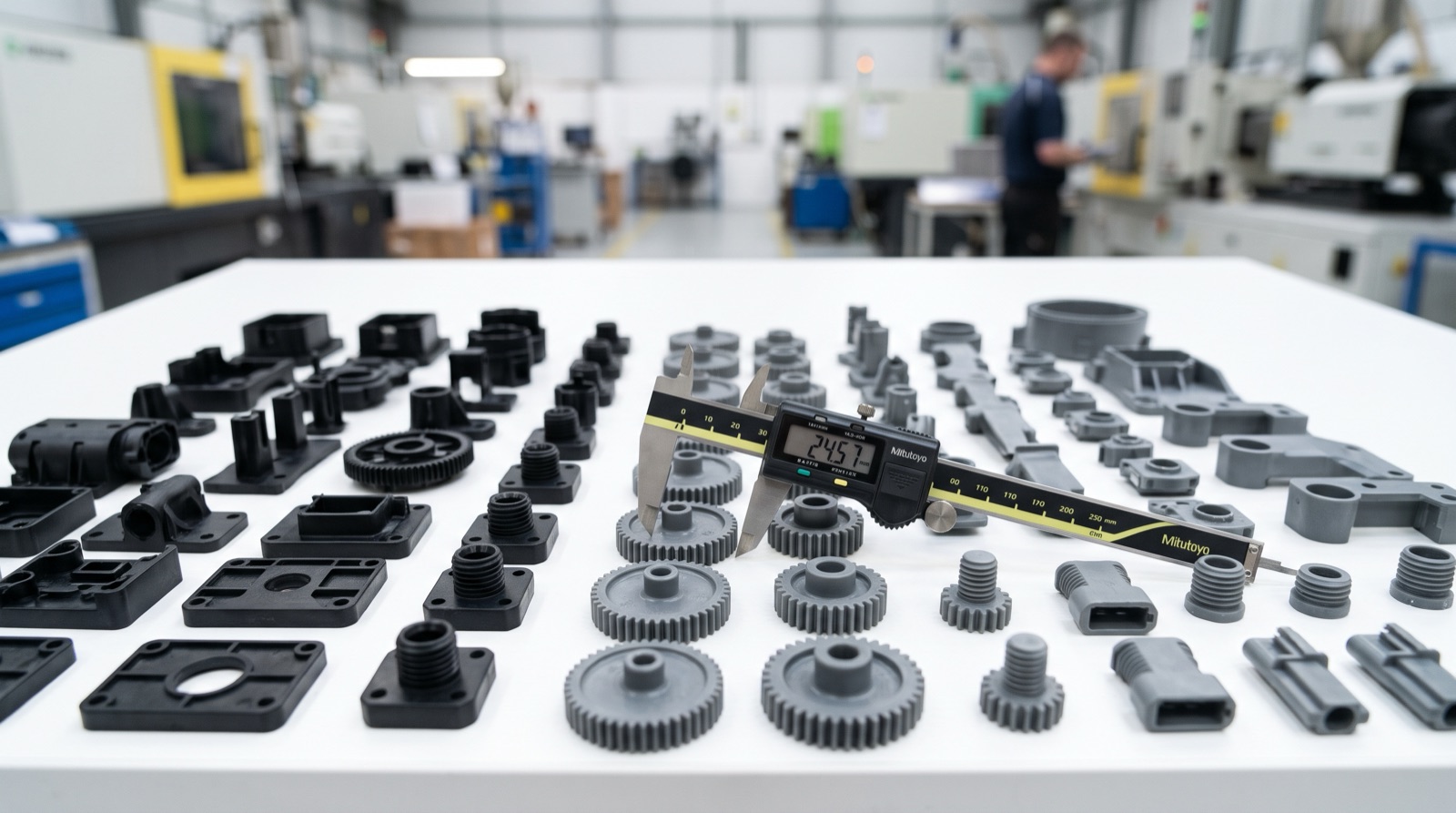
Product teams in the UK often hit an awkward manufacturing gap between 3D printed prototypes and full scale mass production. You may need 250 to 5,000 parts in real engineering polymers for field trials, regulatory certification, early customer sales or legacy spare parts, without committing to massive overseas minimum order quantities. Low volume and bridge injection moulding solves that exact commercial and engineering gap.
What Is Low Volume and Bridge Injection Moulding?
Low volume injection moulding uses real injection presses and production grade thermoplastics to manufacture smaller batch quantities, typically from a few hundred up to 10,000 components per year. Bridge moulding uses the same approach to keep customer supply moving while high cavitation production tooling is being engineered or while initial market demand forecasts are still maturing. Both approaches allow UK engineers to test real world assembly tolerances, chemical resistance and mechanical fatigue long before signing off six figure tooling budgets.
When Low Volume Injection Moulding Beats 3D Printing or CNC
- True production polymer properties: 3D printing is ideal for early form and fit models, yet regulatory testing and mechanical loads usually require genuine injection moulded ABS, PP, Nylon (PA6/PA66), Polycarbonate, Acetal (POM) or TPE.
- Surface finish and tight repeatability: Injection moulding delivers uniform wall thickness, crisp ribs, reliable snap fits and consistent surface texture across every unit without layer lines.
- Lower unit cost past 100 to 300 pieces: Once batch size passes a few hundred parts, CNC machining and additive manufacturing become slow and expensive per unit compared to rapid press cycles.
- Repeatable colour and flame ratings: Production compounding lets you mould exact RAL colour matches, UV stabilised outdoor enclosures or UL94 V0 electrical housings straight off the tool.
Smart Tooling Strategies to Control Upfront Spend
Managing tooling cost is central to making low volume UK moulding commercially viable. Several proven strategies keep capital outlay lean without compromising component precision:
Single Cavity Tooling
Starting with a single cavity mould lowers machining cost and shortens lead time while delivering identical part quality to a multi cavity production tool.
Aluminium or Pre Hardened Steel Inserts
For modest lifetime volumes in non abrasive polymers, aluminium or P20 pre hardened steel tools cut faster and cost less than fully hardened H13 production moulds, while still holding tight dimensional tolerances across thousands of cycles.
Master Unit Die (MUD) Bolsters
Using interchangeable cavity inserts inside a standard bolster removes the expense of manufacturing a complete custom mould base for every part, which is ideal for families of brackets, covers or fittings.
Simplifying Undercuts Early
Before cutting metal, a quick Design for Manufacturability review often eliminates unnecessary side actions by adjusting split lines, pass through cores or snap geometry, saving thousands in tooling complexity.
Combining 3D Printing with UK Injection Moulding
At Shiraz Plastic in Manchester, we offer in house 3D printing alongside our 18T to 150T injection moulding presses. Clients frequently validate ergonomics, enclosure clearances and assembly jigs using 3D prints first, then transition seamlessly into injection moulded parts from 1g to 500g once geometry is locked. Having both processes under one roof keeps engineering feedback tight and eliminates translation errors between prototype houses and production moulders.
Avoiding Overseas MOQ Traps and Supply Delays
Overseas factories often insist on high minimum order quantities to justify container shipping and setup time, tying up your cash in slow moving warehouse stock. Working with a flexible UK moulder lets you order realistic batches aligned to actual customer demand, inspect samples face to face and adjust revisions without waiting two months for sea freight. If product demand accelerates later, your tool is already proven and ready for higher scheduled call offs.
Frequently Asked Questions
What batch sizes count as low volume injection moulding in the UK?
Low volume runs typically range from 100 to 10,000 parts per year, often delivered in scheduled call offs that match your assembly line or sales rate.
Which polymers are available for short production runs?
Shiraz Plastic moulds both commodity and engineering thermoplastics including ABS, PP, HDPE, LDPE, PA6 and PA66 Nylon, Polycarbonate, Acetal (POM) and TPE, with colour matching and recycled grades available.
Can you help review my CAD file before tooling is quoted?
Yes. Send your STEP or IGES files to our Manchester engineering team for practical DFM feedback on wall thickness, draft angles, gating and cost saving adjustments.
What part weight range can Shiraz Plastic mould?
Our 18T to 150T presses manufacture precision plastic components from 1g to 500g, supported by post moulding assembly and ultrasonic welding where needed.
Request a UK Injection Moulding Quote
Shiraz Plastic manufactures precision plastic components from 1g to 500g on 18T to 150T injection moulding presses at our Clayton, Manchester facility, alongside mould transfer, tooling support, assembly, ultrasonic welding and 3D printing. Request a UK Injection Moulding Quote online, email mohammad@shirazplastic.co.uk or call 0161 230 6555.


